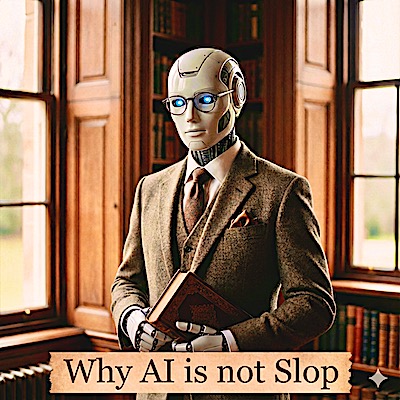
Calling AI “slop” is satisfying. It is blunt, visual, and emotionally accurate in moments when the internet feels flooded with junk. But it is also imprecise. AI is not slop. Slop is what happens when incentives, laziness, and scale collide with powerful tools. Confusing the tool with the outcome misses the real story.
Artificial intelligence does not generate meaning on its own. It generates outputs based on patterns, probabilities, and instructions. That matters.
Most examples people point to as “AI slop” are not failures of intelligence but failures of use. Mass produced blog spam, fake product reviews, hollow listicles, and auto generated social posts exist because platforms reward volume, speed, and engagement over care and accuracy. AI simply makes it cheaper and faster to do what the internet was already drifting toward.
When used well, AI does the opposite of slop. It compresses cognitive labor. It helps people outline ideas, test arguments, summarize complex material, translate languages, and prototype creative work. For teachers, it can help generate lesson scaffolding. For writers, it can function as a thinking partner rather than a ghostwriter. For programmers, it can surface edge cases and documentation faster than memory alone. None of that is slop. It is leverage.
The deeper issue is that AI exposes weaknesses in our information ecosystem. We lack strong norms around provenance. We do not consistently label synthetic content. We reward speed over verification. We teach people how to produce content but not how to evaluate it. AI did not create those gaps. It illuminated them with stadium lighting.
Calling AI slop also collapses an important distinction between low effort output and low intelligence. Many AI systems are remarkably good at pattern recognition, summarization, and synthesis within defined constraints. What they lack is judgment, lived experience, and moral accountability. That is not sloppiness. That is a boundary condition.
If everything AI touches gets dismissed as garbage, the conversation stalls. The real challenge is not stopping AI, but shaping the systems around it. Better incentives. Better labeling. Better education. Better expectations. Slop thrives where nobody is rewarded for care.
AI is not slop. Slop is what happens when we ask machines to maximize output in systems that no longer reward meaning. Fix the systems, and the same tools suddenly look a lot more like instruments than trash.