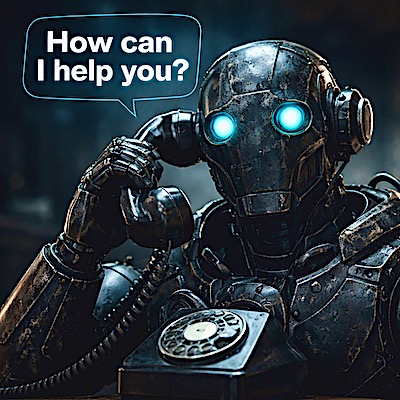
Customer service used to mean friction, yes - but it also meant resolution. You waited, you complained, you escalated, and eventually a human with authority fixed the problem. Today, that entire social contract has been replaced by a glowing chat bubble that smiles, apologizes, and quietly ensures nothing actually happens.
Corporate chatbots are not customer service tools. They are containment systems.
This isn’t a conspiracy theory; it’s a design goal. Modern enterprise chatbots are optimized around a metric called deflection - how many users never reach a human agent. From a balance-sheet perspective, a customer who gives up looks identical to a customer who was helped. The system records “interaction complete,” the company records savings, and accountability dissolves into vapor.
The result is a new ritual of frustration. You type a question. The bot rephrases it back to you incorrectly. You clarify. It apologizes. You request a human. It expresses empathy. You repeat “get a human” like an incantation from an older internet. Nothing happens.
The phrase still exists, technically. Functionally, it has been neutralized.
Most chatbots are trained to treat requests for human help as user dissatisfaction signals, not escalation commands. That means the system responds with calming language, delays, or requests to rephrase - anything except handing control to a person who can override policy. The bot’s friendliness is not empathy; it is behavioral damping.
This is why people now search for third-party sites, Reddit threads, and secret phone trees just to talk to a human. The existence of “get a human” websites is not clever innovation. It’s an indictment. When customers need cheat codes to reach support, the system has failed at its most basic function.
Chatbots also quietly retrain users. You stop explaining context because stories confuse the model. You learn to speak in blunt keywords. You remove nuance. Over time, humans adapt to machines instead of the other way around. This phenomenon - called interactional narrowing - turns communication into ritualized submission. Say the right words or be trapped in the loop.
The most dangerous aspect isn’t inefficiency. It’s deniability.
When a human agent lies or makes a mistake, there is a name, a supervisor, a paper trail. When a chatbot gives incorrect information, companies hide behind disclaimers: “This interaction is not binding.” Responsibility is outsourced to software that cannot be held accountable and was never authorized to decide anything meaningful in the first place.
Companies defend this by pointing to speed and scale. Bots answer instantly. Humans cost money. But speed without resolution is not service - it’s theater. A fast wrong answer is worse than a slow correct one, especially when it blocks escalation.
None of this means automation is evil. Chatbots are excellent at trivial tasks: order status, store hours, password resets. The failure occurs when companies deploy them as gatekeepers instead of gateways - when bots are used to prevent human contact rather than prepare for it.
Customer service is not a cost center problem. It’s a trust problem.
And every time a chatbot says “I understand your frustration” while doing absolutely nothing, that trust erodes a little more. The bot doesn’t need to be smarter. The company needs to be braver - willing to let humans handle human problems again.
Until then, “get a human” remains what it has become: not a command, but a protest.